
6 kits available
KS1, KS2
See below for KS 3/4 and A level
Each kit includes 6 junior microscopes (specially designed for use by young children) and one binocular stage microscope, magnifying glasses, and desk lamps for illumination. There are samples of many everyday substances and biological material mounted onto cardboard slides for study under the microscopes and using hand-held magnifiers. The kit comes with a set of teachers’ notes, with suggestions for various activities, and a set of magnification posters.
There is the option of borrowing either an additional microscope and the flexicam (see Flexicam listing)
• Read the Full kit Content: item-by-item (May vary slightly for each kit)
• Read magnification teachers’ notes
2 kits available
KS3, KS4
A set of 10 microscopes with inter-changeable objective lenses – x4, x10 and x40 – for more detailed work.
One set comes with lamps and a poster showing parts of the microscope and how to make slides, while the other set has integral stage lighting.
Want to explore some scientific images? Check out this ink:
Microscopes 4 schools – project based at the MRC-LMB in Cambridge
Advanced Microscopes (AS/A2)
The following 4 microscopes are all suitable for sixth form work. Each comes with an instruction manual and quick start guide.
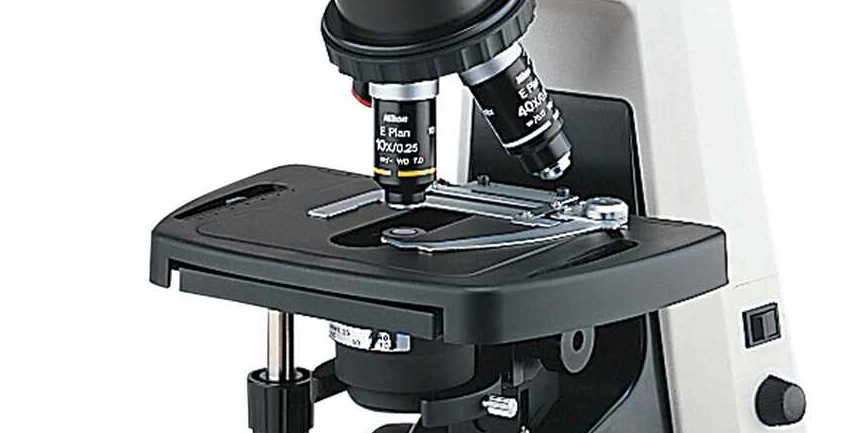
Nikon Eclipse 200 Binocular Microscope
This is a high resolution microscope with a camera attachment if required. Eyepiece lenses x10, objective lenses x4, x10, x40, x100 and a built in mechanical stage.
For more information, click here
Novex Compound Microscope
A high resolution microscope with eyepiece lenses x10 and x16, and objective lenses x4, x10, x40 and x100 (oil immersion). Suitable for viewing bacterial cells (with the oil immersion lens)
For more information, click here
CETI Sonar Binocular Microscope
Magnification from x7 to x45. The specimen can be lit from above or below.
For more information, click here
Olympus Stereo Microscope
Eyepiece lenses X10; objective ring x2, 3 or 4; the specimen can be lit from above or below. Ideal for detailed observation of whole plant specimens